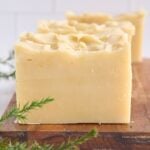
Winter Forest Cold Process Soap
A fir, pine, and cedar cold process bar at 5% superfat — one make-day, then a long passive cure. Makes about 3 pounds / 10 bars (standard 10-inch loaf mold).
Servings: 10 bars
Equipment
- digital scale
- Stick blender
- 10-inch loaf mold
- safety goggles and gloves
- Whisk
- curing rack
Ingredients
Oils
- 318 grams olive oil 11.2 ounces (35%)
- 272 grams coconut oil, 76° 9.6 ounces (30%)
- 136 grams shea butter 4.8 ounces (15%)
- 136 grams sweet almond oil 4.8 ounces (15%)
- 45 grams castor oil 1.6 ounces (5%)
Lye solution
- 128 grams sodium hydroxide 4.5 ounces
- 284 grams distilled water 10 ounces
Add-ins
- 2 teaspoons kaolin clay anchors scent, silky lather
Fragrance Option A — essential oil blend
- 16 grams fir needle essential oil Siberian or balsam
- 10 grams Scotch pine essential oil
- 9 grams cedarwood essential oil, Virginia
- 5 grams sweet orange 5-fold essential oil or litsea cubeba
- 3 grams patchouli essential oil don't skip it — at this ratio it reads as forest floor and acts as the fixative
- 1 gram cinnamon leaf essential oil
- 1 gram thyme essential oil
Fragrance Option B — fragrance oil
- 40 grams CP-tested "Fraser Fir," "Christmas Tree," or "Balsam & Cedar" fragrance oil from a soap supplier; cedar-forward blends are closest — check the max usage rate and acceleration reviews before buying
- 5 grams patchouli essential oil to deepen the fragrance oil
Instructions
Safety & prep
- Gear up. Put on goggles, gloves, and long sleeves, and open a window.
- Weigh everything. Pre-weigh every ingredient before you start, including the fragrance in its own cup.
Lye solution
- Make the lye solution. Add the sodium hydroxide to the distilled water (never the reverse), stir, and set aside in a safe place to cool to 90–100°F.
Oils & clay
- Melt the hard oils. Melt the coconut oil and shea butter, then stir in the olive, almond, and castor oils.
- Whisk in the clay. Whisk the kaolin clay into the oils and bring them to 90–100°F, keeping them on the cool side since conifer scents can speed up trace.
Combine & fragrance
- Blend to emulsion. Pour the lye water into the oils and stick-blend in short bursts just until you reach a thin, uniform emulsion. Don't push it to thick trace.
- Add the fragrance. Pull out a cup of batter for the green swirl first if you're coloring, then pour in the fragrance and stir by hand with a whisk, not the stick blender.
Mold & rest
- Mold the soap. Pour the batter into the mold and texture the top.
- Cover and rest. Cover with cardboard and leave undisturbed for 24 to 48 hours.
Cut, cure & store
- Cut the bars. Unmold the loaf and cut it into 1-inch bars.
- Cure the bars. Cure 4 to 6 weeks on a rack, turning the bars weekly.
- Store them covered. Once cured, keep the bars in a closed cardboard box or paper bags — pine's bright top notes are the first to wander off in open air.
Notes
This recipe is calculated at 5% superfat using standard SAP values. If you swap any oil, take 30 seconds to re-run the lye calculation. Use Fragrance Option A or Option B, not both.