
Start a Commonplace Book (A Simple Indexed Notebook) for Your Home Life

Inside: how to start a personal collection of your thoughts, advice, and memories as a homemaker.

First of all, the enemy of this book is overthinking it. It’s not a system, a productivity method, or something that you have to do “properly”. The whole idea is simply to start a book of what you want to remember, personally, for whatever reason. It’s not like a diary, which is more of a story. It’s your experience and knowledge, written for future-you to refer to.
Most important to understand is that it’s not a new THING to manage. You will never put “write in commonplace book” on your to-do list. You will add new things as they come up in your life.
This is one of those things where the best advice is “Get started today and make it however you want!” But if you, like me, appreciate a little bit of structure and being told what to do, I’m your girl. Let’s do this.
What a commonplace book is
I love history but not boring definitions, so let’s keep this short. The geniuses of history kept these, not as journals (although they often did that too), but almost as a way to get their brains on paper so they could refer back to their thoughts later.
The ideas started in ancient Greece, had a little return to coolness during the Renaissance, and then again during the 19th century. My favorite ancient Roman had one (yay Seneca), as did Mark Twain, and many, many “normal” people.
Why YOU would want to bother with this
As a less impressive individual than Mark Twain, you might be wondering why an everyday person would create such a book. Isn’t there enough documentation happening with cell phones, social media, and all our text messages? And the answer is no; there’s not really anything like this for the everyday person. Social media is mostly for show, cell photos get lost, and the everyday DOING of our life is so digital that it gets lost. You’re learning and experiencing so much every day, and then it’s either going into your phone or mind, neither of which will outlast you or be all that easy to reference later.
Imagine having a book from your grandmother that had her secret pickle recipe, her timeline for hosting Thanksgiving, that brand of soap she liked, the foolproof way to keep mice out of the basement.
Yours, of course, will be more modern, and that’s fine- it should be truly REAL and helpful, not some sort of scrapbooking fantasy. It might be your favorite app for photo sorting next to a printed recipe for bagels kneaded in the bread machine next to the instructions for your automatic cat feeder you keep losing every time you go on vacation.
This is helpful and practical for future-you, of course, but it’s more than that. It’s a way to slow down and reflect on how you spent your life and all the things you did and learned. And it’s a way to pass that down too, naturally.
I think of this as a blog, but one you keep on paper, only for yourself and your family.
What you need
There’s really only one thing you need to buy for this, but you must get it right. You need a book, and it has to be one you can write on, not a binder where you’re slipping papers into page protectors. It has to be something that you enjoy using, that’s not too big, not too small, that will stay open flat if that’s what you want. Something that’s big enough to hold basically the ideas of your life but where the pages aren’t so big that getting started feels intimidating, like you have to design something before you begin.
The binding should be high-quality, not because you’re snobby, but because it’s going to be opened and flipped through thousands of times. The pages should be thick enough that you can write in ink without the ink bleeding through. Oh, and absolutely crucially, you should get one with numbered pages or take a few minutes to number start to finish before you begin.
But that’s all you need besides a pen and your brain: no dividers, no stickers, no tabs.
Setup (the indexing method)
I’m going to walk you through how to set it up step-by-step, and I hope this doesn’t feel limiting because you don’t have to do it this way. You could, of course, organize this however you want, but structure is helpful. This indexing method comes from none other than John Locke, who got the social contract all figured out for us. Let’s see if he can help us organize a book, too.
Leave a few (four is good) pages blank at the front for your alphabetical index.
You could try to guess all the categories you might need, such as recipes, memories, gift ideas, and quotes. But invariably this fails. You can’t anticipate what you’ll have a lot of, what you’ll have a little of, what will be important to you five years from now, and the things that you care very much about now but won’t care so much about in the future. This is a good thing. Your life will grow and change and expand, and the book will be able to grow and expand right along with you as long as you don’t make the fatal mistake of organizing it by category from the very beginning.
There’s one timeless way to categorize things, of course, and that is alphabetically. It’s what John Locke recommended, and what we will do here is a simplified version of his.
Make a grid
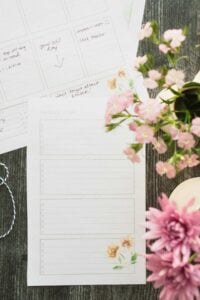
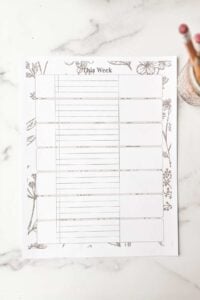
Make boxes for every letter of the alphabet, and leave it as an empty grid.
Save This Post
You'll join my email list which you will love. And if you don't, unsubscribe in one click. ❤️
When a topic that begins with that letter is used, you write the page number in that box. An image is the clearest way to explain:

In this layout, you can see that I allowed for lots of pages so each letter has plenty of room. It’s going to need to hold lots of things in the future.
It’s just an index, but you don’t want to have to limit your categories because of physical space. Let me show you what it could look like at the end of year one:

And then after three or four years, how it organically grows:

Cool right? If we tried to think of all these topics or make broader topics and then add subcategories later, it would be all wrong. The book needs to fit your life. You don’t have to categorize the things in your life into the book, and this method is the most flexible.
But remember we’re still at the beginning. All you have to do is set up your index. I just wanted you to see how it would evolve.
What to include
This is where it gets personal, and all I can do is tell you what I include. Some of you are artistic and will want to put sketches and stickers and make it beautiful, but that stresses me out, so I never have and never will. I put notes, and I only put notes if they’ll help me in the future.
This way it doesn’t devolve into a diary of sorts. That’s not what I want. I don’t want it to be secret. I don’t want to be embarrassed if someone else reads it. I want it to document my days in a way that helps my future days. This is how I use it. Many, many people naturally turn theirs into more of a diary as they go. That’s totally up to you.
Here are the notes I keep:
- Recipes. Not the full written recipe, but what I used for a certain occasion and where to find it
- Gift ideas: what I want to get someone or what I already did
- Quotes I like. I write these out fully rather than where they can be found.
- Books I want to read and movies I want to watch. Some for me, some for the family
- Measurements of our house: the inside of our windows, our family room, the area rugs we currently have so that, if I’m shopping, I can compare to what exists, our garage dimensions, our porch width, etc.
- Paint colors: what we have and ones I’ve seen that I like.
- Restaurants: favorite dishes, dishes I’d like to try, notes on whether they take reservations or how to request a seat.
- Funny things my kids have said. This definitely is memory-keeping and breaks my own rule, but I want to have it.
- Notes about my garden: varieties I liked, varieties I hated, dates of frosts, what worked and didn’t work against pests. Here I will indulge in a little bit of attempted artwork and sketch out garden plans.
- Holidays: what I did ahead of time, recipes we liked or didn’t like, traditions, things we want to try
Filling yours up
This is one of those things where examples are helpful, but they’re also not helpful. The worst thing you could do is read my list and then fill out your index with paint colors, restaurants, funny things my kids have said. That’s not how it works. You have to live your life and write things down as you feel they will be useful to you and index them as they come.

If you run out of room on a page, you don’t have to worry. Just go to the next blank page in your index and continue there. You can see on the example pages that Easter is on two non-consecutive pages and that’s okay. Everything is working as designed.

All you need to do now is get your book, make your boxes with letters in them, and put your book somewhere you will use it. Think of one thing that you’re tired of looking up and remembering. Write it down and index it.
The next time something like that comes up, do it again.
Don’t worry about adding to it on a schedule or making this into a fancy system. Your hard-earned wisdom will fill it up all on its own. And one day, someone very special to you will be very glad to have it. Good luck!












For years I always had a 5-subject spiral notebook handy for jotting down things I didn’t want to forget, knew I would need later, or even shared with my daughters as a reference book. I kept home decorating ideas, home maintenance and cleaning, menus and recipes from magazines, homeschooling notes and ideas, and Thanksgiving and Christmas notes and lists, one for each section. But making an index was something I didn’t think of and that would have been so much better to have utilized. It would have made my “homemaking notebook” as I called it less restrictive. I’m going to get on this right away because it will be so much better! Now to look through my blank books for a pretty one just right for this! Thank you for sharing!
hi donna! yes i was the same- i had a binder. the sections intimidated me and always felt too broad or too narrow.
Well, I gathered all my Post-It notes and index cards on which I jotted down things I want to remember and have to pass on to my daughters and started copying them into my book that I bought–yes, this idea deserves a pretty book–and I am on page 6 so far. While I was at it, I started to make notes about things that I’ve used myself on the chance that one day this book will pass down to my children and they will find it helpful. Again, I appreciate you sharing this idea with us!
hi donna! i love it. they will surely treasure it. 🙂