
The Best Things to Buy at Thrift Stores (and How to Spot the Good Stuff)

A guide to thrift stores, estate sales, yard sales, and Facebook Marketplace… and how to tell beautiful, well-made things from 15-year-old junk.
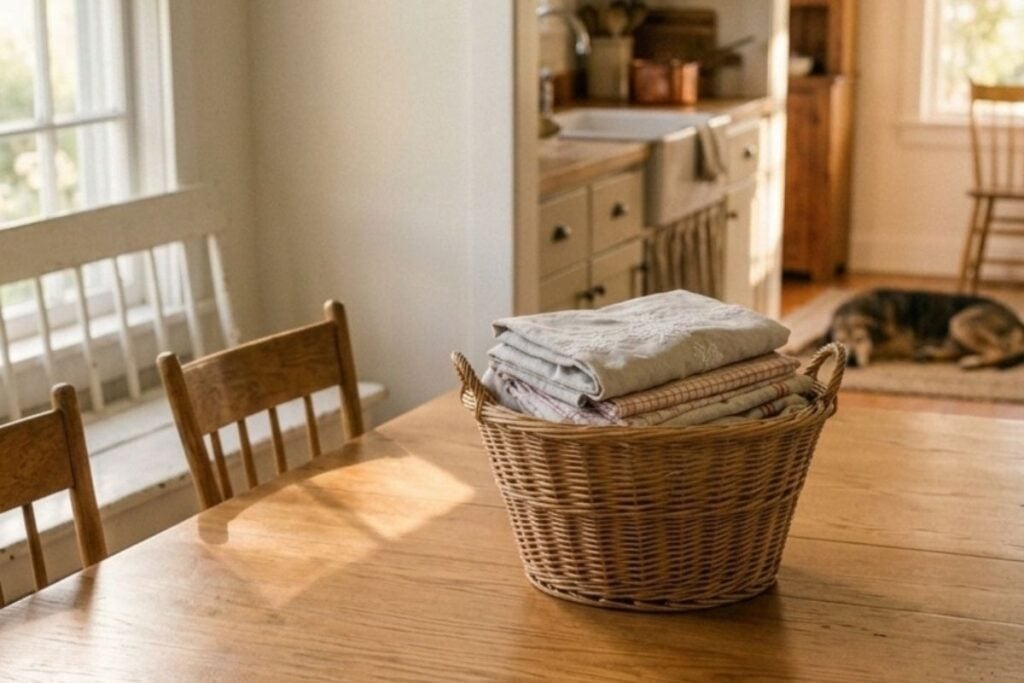
Here is something I think about a lot: the stuff we actually use every day is usually the ugliest stuff in the house. The basket the laundry lives in. The crock the wooden spoons stand in. The jar the cotton balls sit in. The trash can, the broom, the drying rack. We buy these things for function, we grab the cheapest plastic version, and then we look at them a hundred times a day.
It doesn’t have to be that way. A beautiful version of every one of those humble objects exists. But bought new, it’s expensive, sometimes shockingly so. The only realistic, frugal way to surround yourself with the pretty version of your everyday necessities is to buy them secondhand.
And the difference it makes is HUGE. A wicker hamper instead of a plastic one. A stoneware crock instead of a utensil caddy. It costs a few dollars and it changes how a room feels.
The catch (and it is a real catch) is that you have to be discriminating. Thrift stores and yard sales are full of junk. Most of what you see will not be attractive, and a fair amount of it is poorly made stuff that won’t last. So this is a guide to finding the good stuff: where to go, how to tell quality from garbage, and the exact words to search so the good stuff comes to you.
Where to look (and what each place is good for)
Thrift stores are your bread and butter for small home decor….baskets, frames, glass, crocks, books. The stock turns over constantly, prices are tiny, and you can pop in weekly. The trade-off is that you have to dig, and you have to go often.
Estate sales are the motherlode for quality, especially furniture. You’re walking through an entire household and everything is priced to clear out by the last day. This is where solid wood and real materials live. Go early for the best selection, or go on the final day when many sales drop to half price.
Facebook Marketplace lets you shop from your couch, which is wonderful — but only if you know the right words to search (more on that below). It’s especially good for picking up local furniture without driving all over town.
Yard and garage sales are hit or miss, but cash is king and the seller genuinely wants the stuff gone. It’s the easiest place to negotiate. Bring small bills and don’t be shy about offering less. I never, ever go to these, because I find that most of what people are trying sell is just trash (with the except of children’s clothing and toys).
How to tell if something is well made or just old junk
This is the skill that separates a house full of treasures from a house full of someone else’s mistakes. A few tricks:
Pick it up. Weight is the single biggest giveaway. Real materials: solid wood, glass, brass, cast iron, stoneware, thick ceramic, have heft. Particleboard, resin “wicker,” thin pot metal, and acrylic feel suspiciously light for their size. If your hands expect something to be heavier than it turns out to be, put it back down.
Flip it over. The truth lives on the bottom and the back.
- Drawers: pull one all the way out. Interlocking, finger-like dovetail joints mean someone built it to last. Stapled corners and a thin cardboard bottom mean it was built to sell cheap and fast.
- Furniture backs and undersides: is it solid wood, or thin plywood and cardboard? Veneer is perfectly fine when it’s laid over real wood. But if you see a chipped edge revealing a tan, crumbly, sawdust-looking core, that’s particleboard. It won’t survive a move, let alone a refinish.
- Look for a maker’s mark. A company name stamped into the bottom of a crock, the back of a chair, or the underside of a platter usually means a real manufacturer who stood behind the piece. Stamps like “Made in USA,” “Made in England,” or “Made in Japan” often (not always) point to older, sturdier production.
Ask which way it’s aging. Honest materials get better with time; fake ones fall apart. Solid wood develops a patina. Brass and copper grow a glow. Real wicker softens. But laminate peels, faux finishes chip to reveal the MDF underneath, plastic yellows and goes brittle, and pot metal pits. So when you’re on the fence, ask yourself: will this look better in ten years, or worse? Buy the things that will look better.
A few quick tells:
- Glass vs. acrylic: glass is cold to the touch and gives a clear ping when you tap it. Acrylic sits at room temperature and gives a dull tonk. If something rings like a bell when you flick it, that’s crystal!
- Real metal vs. painted plastic: weight, plus that same cold-touch test.
- Baskets: natural fiber (wicker, rattan, seagrass, oak splint) has tiny irregularities and a faint planty smell. Resin woven to look like a basket is suspiciously perfect and uniform.
When in doubt, be picky and walk away. There’s always more.
What words to search on Facebook Marketplace
Here’s the secret: the people selling the good stuff and the people selling the junk use different words. If you search the generic name of an object, you’ll drown in cheap, broken, plastic versions. Search the words quality sellers use, and the good stuff floats to the top.
Search by material and era, not just the object.
- Not “dresser” → search solid wood dresser, oak, maple, walnut, teak.
- Not “basket” → search wicker, rattan, seagrass, splint basket.
- Not “jar” or “container” → search crock, stoneware, ironstone, enamelware, apothecary.
Search the magic seller phrases. Certain words signal someone clearing out a houseful of older, well-kept things and pricing to move:
- estate sale, estate, downsizing, moving sale, must go
- grandma’s, grandmother’s, inherited, from my mother’s house
- antique, vintage, primitive, mid century / MCM, farmhouse
Search brand names. If you know one good brand in a category, search it — it surfaces the quality tier, and occasionally turns up a mislabeled bargain a seller didn’t recognize. (Longaberger for baskets, Pyrex for glass, the old cast iron names for cookware.)
And the most important one: search the beautiful version of the ugly necessity. This is the whole point of this article. You are not looking for a “laundry basket,” you are looking for a wicker hamper. Not a “trash can,” an enamelware bin or wooden waste basket. Not a “utensil holder,” a stoneware crock. Not a “drying rack,” a wooden clothes drying rack.
1. Baskets
They are EVERYWHERE. I can’t explain why everyone is getting rid of their baskets and selling them at thrift shops…but it is basketpalooza at these places. I have never spent more than 3 dollars for one unless it was a Longaberger, which I rarely buy. That’s cheaper than a gift bag, if you want a cute way to package up a gift.
You can use them for storage and organization all over the house, for anything for tea bags to firewood to shoes to laundry. Their price and versatility makes them one of the very best thrift store deals.
2. Picture frames
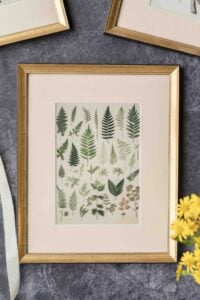
Again, these are everywhere. Just make sure you check the back to make sure it has both hooks for hanging on a wall, or a table display foot, depending on what you want it for. Don’t forget you can easily paint it to your taste. Often you will find framed prints that are ugly, but the frame itself is nice. Don’t be afraid to rip out what’s inside. Concentrate on the bigger sizes, because they are so expensive at stores.
3. Wreaths
Only for the wreath form! It’s usually very easy to cut off or pull off whatever tacky thing is on them, and it is still much cheaper than buying a brand new form. You’re going to have to look past what’s on the wreaths, because the decorations themselves are usually awful. If you’re looking for a specific size, bring a ruler, because the enormous fake flowers will sometime trick you into thinking that the wreath is bigger then it is.
4. Kitchen Items for Organizing and Display
Even if you are squeamish about putting your food in something used, there are plenty of uses for food storage containers that don’t involve food.
- Glass jars for cotton balls and other bathroom items
- Crocks for wooden spoons and spatulas
- Plates or platters for hanging on the wall
- Mason jars for buttons, matches, kids small treasures, and other tiny things
5. Reference or Display Books
No one is buying these things, but kids love them. They are so nice to have on a shelf for the little ones to flip through and stumble on new things that interest them. Keep an eye out for reference books like atlases, bird and bug guides, and state maps. Encyclopedia sets can be found free or cheap and are both charming and lovely for kids.
Books in general are one of the best things to buy at thrift stores in terms of value, but the selection is usually not great for adults. Never, ever, ever, ever pay full price for something like this. Remember you can throw out the ripped dust jacket and have a pretty hardback book.
Oh, if you ever see an old globe with countries that no longer exist, buy it! They can be worth a lot on the resale market.
6. Vases or Other Flower Holders
Everything from pretty blue and white ceramics, teapots, and large vintage mason jars can make a beautiful flower vase. Bud vases, for tiny flowers, seem to be everywhere. If you are looking for a frugal way to have flowers in the house, grow your own vintage cutting garden!
Don’t forget about potting containers too. Any large container that you can drill a hole through will work for outdoor containers or for houseplants. Look for a cheap plate as a saucer.
7. Candlesticks or Other Candleholders
Another thing that has fallen WAY out of style, but is still lovely for the mantle and dining room. They are almost free. Don’t be afraid to mix and match different styles. Taper candles can be be purchases very cheaply at restaurant supply stores.
8. Wooden Furniture
Look for things with no moving parts. Think wooden chairs, step stools, benches. Doll furniture can be found easily too. Easy to repair, no drawers to get stuck, no upholstery to be totally grossed out by. Be picky! Are you really going to sand and paint that piece? If not, there is nothing wrong with letting it go. This is last on my list because it’s a challenge. Craigslist is way better for furniture.
Keep in mind:
- Don’t expect to walk in the door and think “wow, I love this stuff,” the majority of it is not attractive, and you will have to dig.
- Keep a list, written down, of what you are looking for. It can be general or specific, but give yourself some direction. (It is helpful to know your overall style and house colors, too. Thrift store shopping is a big part of slow decorating.)
- Bring small bills.
- Many stores have a minimum purchase amount for credit cards and your purchase probably won’t hit the minimum, since the best things to buy there are very inexpensive.
- Be picky. If there is nothing you like, just leave without buying anything. This is hard for me because I feel like it’s rude, but it’s not. Many people come every week to check out whats new, and leave if nothing appeals to them.
Happy thrifting!
Save This Post
You'll join my email list which you will love. And if you don't, unsubscribe in one click. ❤️















I’m always up for tips to a better home. Thank you.
Hey Lori, that’s great to hear! I hope you find the tips helpful. Thanks for reading!
Great Content! Thank you!
To help keep your home from looking like a thrift shop, adopt the one in one out rule. For every item you bring home, donate one item.
smart, shelley!
This is a wonderful, very detailed post about thrift shopping. I have always loved thrift shopping for ALL the reasons you describe above. And what amazes me is the absolutely gorgeous things people donate. I am often so shocked, but in a good way! I (recently) have had amazing luck with beautiful table runners. For $3 or $4, my dining room table looks straight out of BH&G! Thank you for this inspiration!
I love thrifting! I buy very few things brand new. Underwear and socks, those I get new.
I really have to hold myself back when it comes to knick-knacks. I jus don’t have the room. It really has to be something that I am wowed over, “what a find!”. Beatrix potter figurines – those are worth making room for. I also have to keep culling out stuff I don’t need and don’t love as much.
We really enjoy searching for treasures in thrift shops and yard sales. We have found many wonderful items that are both useful and decorative while still being the rustic style we like. Browsing is relaxing and you can meet interesting people who will sometimes give you leads on things you may be specifically searching for. Baskets are great for corralling loose items all over the house. Thank you for the great article!
So true about meeting people! It’s such a friendly environment. Thanks for the lovely comment!
Ooh ooh ooh, a pet topic of mine. I’d also add:
Children’s mittens because they’re perpetually lost
Greeting cards with icons on them—I frame them (in a thrifted frame) for baptism gifts
Pretty handkerchiefs—one for every pocket
Ok. Are we taking handkerchiefs into which a nose is blown? I really want to adopt this, but I’m having a hard time. Is it gross? What do you do with it if you’re out?